Policy Exception in GRC
A policy exception is a formally documented and approved deviation from a policy when a
Read More

Control and Control Objective
In Governance, Risk, and Compliance (GRC), a control is a specific
Read More

Enable Now Assist
Now Assist is Service Now’s suite of generative AI-powered experiences integrated into the Read More

Incident Management
An incident, defined as an unplanned interruption to an IT service.
Read More

Problem Management
Problem Management is an ITSM process focused on
identifying
Read More

Change Management
ServiceNow change management is a module that provides
Read More

Policy in GRC
A policy is a formal, high-level statement that defines an organization’s rules, expectations, and guiding principles.
Read More
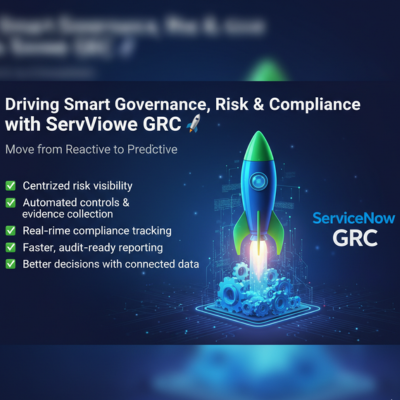
ServiceNow GRC Entity
An Entity is a “person, place, object, or thing” that is tracked for risk, compliance, and audit purposes. Entities act as the fundamental build
Read More

Third Party Risk Management (TPRM)
TPRM is the process of identifying, assessing, mitigating, and continuously monitoring risks associated
Read More

Dictionary Override
Dictionary Override will come into a picture when we have a parent-child relationship between tables.
Read More

Reference Qualifier
It is used for filtering.
They help refine the choices available in a reference field by defining
Read More

HRSD (Human Resource Service Delivery)
It is a Service Now platform module that helps organizations digitalize
Read More

ServiceNow Basics Questions and Answers
ServiceNow Questions and Answers are essential for anyone preparing for interviews, certifications, or working on real-time ServiceNow
Read More
Retroactive Start SLA
In ServiceNow, a retroactive SLA (more precisely, an SLA with Retroactive start enabled) is a configuration option in SLA
Read More
UI Policy
UI Policy is a client-side configuration rule that dynamically controls the behavior of form elements (such as fields, sections, or related lists) based on specified conditions.
Read More
Scheduled Job
In ServiceNow, Scheduled Jobs are used to run scripts automatically at a defined time or interval. They are commonly used for tasks like sending reminder emails, updating records, cleaning up old data, or monitoring SLAs.
Read More
Workflow
Workflow is series of activities that follows execution path.
An Activity is a collection of instructions that can include script, logging, approvals, record processing, timers, wait time, rollback activity etc.
Read More
GlideDate
GlideDate in ServiceNow is a server-side API used to work with date values without time information. It helps developers compare, calculate, and manipulate dates in business rules, scripts, and scheduled jobs.
Read More
Update Set
Update sets are used to capture the configuration data of a table. Update sets can be used to migrate the configuration data that has been done from one instance to another instance (example: from developer instance to test instance).
Read More
Service Portal
Basic widgets in ServiceNow are the building blocks used to design interactive and user-friendly interfaces, especially in Service Portal and dashboards. They help display information like lists, forms, charts, and KPIs in a structured way.
Read More
JavaScript Overview
Programming is nothing but the instruction given by us to machine.
instruction are in the form of statements.
Read More
Data Policy
A Data Policy is a server-side rule that enforces data consistency and integrity by setting fields to mandatory or read-only based on specified conditions.
Read More
View Rule
This rule determines how a record is presented to the user by dynamically selecting the appropriate view based on defined conditions.
Read More
Server Side Script
Server-side scripts in ServiceNow run on the server and handle backend logic and data processing.
Read More
Client Script
Client scripts in ServiceNow run on the user’s browser and control the behavior of forms and fields. They are mainly used to validate user input, show or hide fields, and auto-populate values in real time.
Read More
Overview of ATF
Overview of ATF Automated Test Framework (ATF) in ServiceNow The Automated Test Framework (ATF) is a built-in ServiceNow tool designed to automate testing of your instance
Read More
Scripted REST API
Scripted REST APIs allow developers to create custom web service APIs in ServiceNow. These APIs enable external systems to interact with ServiceNow by defining endpoints,
Read More